Real-Time Active Vibration Compensation in Microgravity Additive Manufacturing via Kinematic Speed Modulation
Ali Dereyurt & Nagkichan Moustafa Impram
IAC-26,A2,IP,17,x113015 · Submitted manuscript
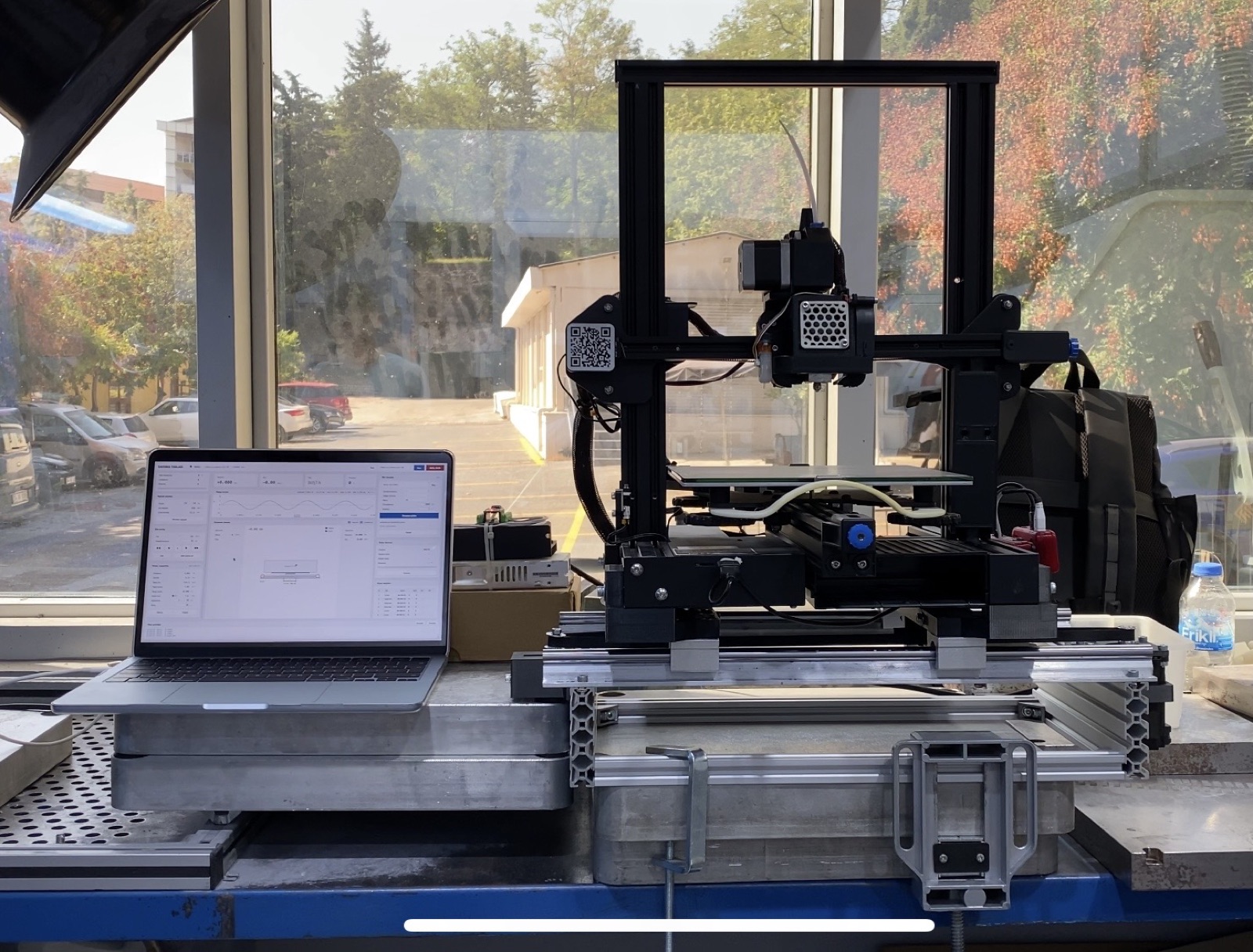
We investigated whether print-head speed modulation could reduce vibration-related surface defects without adding a control actuator. A ground-based FDM printer was mounted on a single-axis motion stage replaying scaled NASA SAMS vibration recordings.
What the ground experiment showed
An offline-converged FxLMS speed profile reduced mean surface roughness by approximately 29% compared with the uncontrolled vibration condition.
Surface roughness on the measured face| Condition | Mean Ra ± SD (µm) | n |
|---|
| Reference | 1.81 ± 0.38 | 4 |
|---|
| Uncontrolled | 3.14 ± 0.43 | 4 |
|---|
| FxLMS profile | 2.24 ± 0.36 | 4 |
|---|
| Sham profile | 3.06 ± 0.25 | 4 |
|---|
Scope and next steps
This was an initial ground-based demonstration using a precomputed profile streamed with the disturbance, not a validated online loop or an in-orbit test. Measurements covered one face per specimen. Timing effects could not be separated from differences in command delivery and print order.
Next steps include online control, measured secondary-path identification and multi-axis testing.
Request the paper